


Updated on 15 September 2026
Dye migration and resublimation are the natural enemy of every textile decorator. Some textiles call for special DTF prints so that your designs keep their full impact on expensive textiles for a long time. The Blockout DTF transfer is our answer to dyes showing through, which can discolour light areas of your design. It makes your work easier and expands your range to include textiles such as jerseys and softshell jackets without a water-repellent coating. In this article, you will find out how dye migration occurs, what you need Blockout for and how to test a new textile.
Resublimation and dye migration: what happens during pressing?
Dye migration and resublimation are processes that make DTF transfer more difficult on certain textiles. Discolouration can become visible immediately or only after the textile has cooled down completely.
Resublimation
In sublimation, colour is introduced into the fabric under heat. When heat is applied again, the colour particles resublimate, turn into gas and reach the surface of the fabric, where they cool down and settle. As a result, they show through the applied design and spoil it. We explain how sublimation works as a printing process in Sublimation explained: how sublimation printing works.
Dye migration
When decorating with a heat press, the dyes are released again, which can impair your print.
In short: dyed polyester can release dyes due to the heat of the press, and these migrate into light areas of your design. We call this dye migration, also known as resublimation.
How to recognise dye migration
A typical sign is a pink tinge in a white back number on a red jersey. Particularly critical are:
- Strong red, orange, neon and dark shades in the textile are the most likely to show through light or white print areas.
- Signal colours such as orange and yellow on hi-vis vests bleed particularly strongly.
- Light areas of the design such as white lettering, numbers and logos are the most likely to show discolouration.


What exactly is Blockout DTF printing?
Blockout DTF works with a special adhesive that holds back dyes from the textile. It reduces the risk significantly, but cannot rule it out for every textile. As with Standard DTF, your design is printed in colour in CMYK and backed with opaque white. The difference lies in the adhesive.
The Blockout DTF transfer reduces the risk of resublimation on critical textiles such as jerseys, softshell jackets without a water-repellent coating and fabrics with a high polyester content. Material, dyeing, temperature, time and pressure all interact, and even identical items can differ depending on their colour and production batch. This is why you test new textiles and batches first.
Blockout is a recommendation, not a requirement. Where there is no risk of dye migration, for example with white polyester, Standard DTF also works, sometimes even better.
Which textiles are suitable for which DTF prints?
What matters is not only the polyester content but also the risk of dye migration. For polyester and blends with at least 40% polyester, we recommend Blockout DTF, and for cotton and blends with at least 70% cotton, Standard DTF. Whether a fabric is light or dark does not decide between Standard and Blockout, the material does. Our article Which textiles are suitable for DTF printing? shows you which transfer suits which fabric, how to classify blends and how to test a new textile.
Typical items for Blockout are:
- Jerseys, sports shorts and complete club kits
- Performance and running shirts, which tend to release dye during pressing
- Softshell jackets without a water-repellent coating
- Hi-vis vests in signal colours
- Work jackets, polo shirts and aprons made of polyester blends
Impregnated, water-repellent coated or silicone-coated textiles are not suitable for Blockout either.
How can you reduce discolouration from resublimation?
With the Blockout DTF transfer, you reduce the risk significantly, so that your designs keep their full impact for a long time. Still test new textiles first: the same model in the same colour, ideally from the same batch, on an offcut or an inconspicuous spot and never on a finished item from a customer order.
Blockout is pressed slightly cooler than Standard DTF, at 120 to 130 °C instead of 130 to 140 °C, for 12 seconds and with medium pressure of about 3 bar. Let the textile cool down completely and only then check the adhesion and the light areas of the design for discolouration. The values are guidelines, as heat presses have different tolerances. You can find all current values in our heat press settings.
Our Sample Pack, with one test print each with DTF Standard adhesive and with Blockout adhesive, is ideal for comparison. Our article Most common mistakes and how to fix them explains what to do if a transfer does not stick or comes off after washing, and how to care for decorated textiles.
Ordering Blockout: formats and express
You can get Blockout DTF in any format, from a single piece to transfers by the metre:
- A4 and A3 for tests, chest logos, names and back numbers.
- Half metre and by the metre at 600 x 500 mm and 600 x 1000 mm for series and mixed designs.
- Blockout custom length: 600 mm wide and 10 cm to 3 m long, and you pay for the length you set up.
- Single design: you upload one design and set the quantity, and the arrangement on the sheet is worked out automatically.
- CUT Blockout at 560 x 1000 mm, pre-cut along your outline. For this, you need a PDF with a cut line in the spot colour CutContour.
- Blockout Designer: you put your sheet together online yourself, without a graphics program.
If you need it fast, Blockout is also available as an express product. You can find the cut-off times and conditions there.
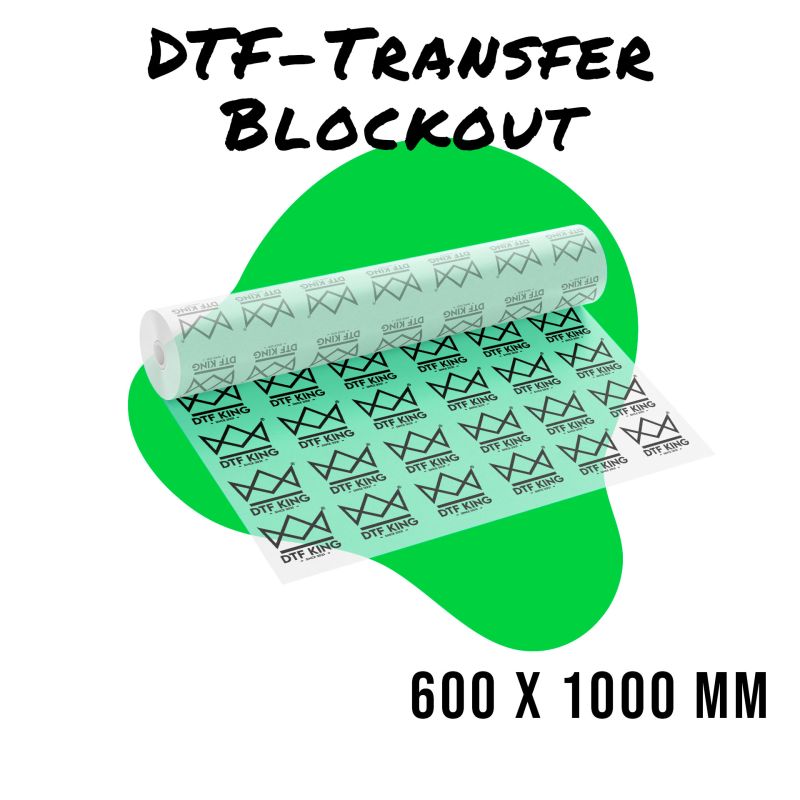 Blockout DTF by the metre
From €14.30
600 x 1000 mm, for polyester
Prices excl. VAT plus shipping costs
View product: Blockout DTF by the metre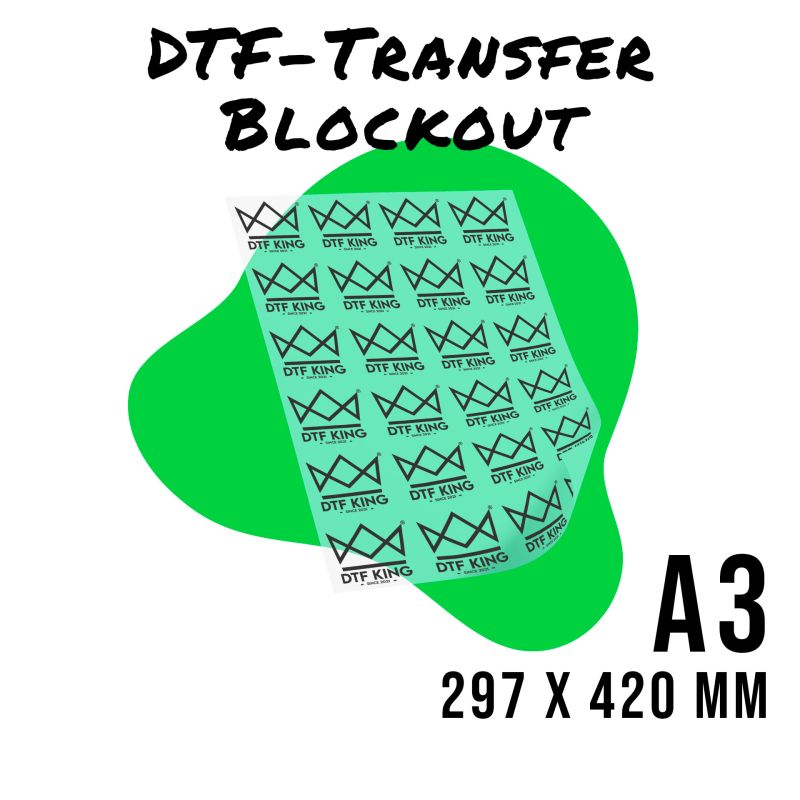 Blockout DTF A3
From €5.90
sheet 297 x 420 mm
Prices excl. VAT plus shipping costs
View product: Blockout DTF A3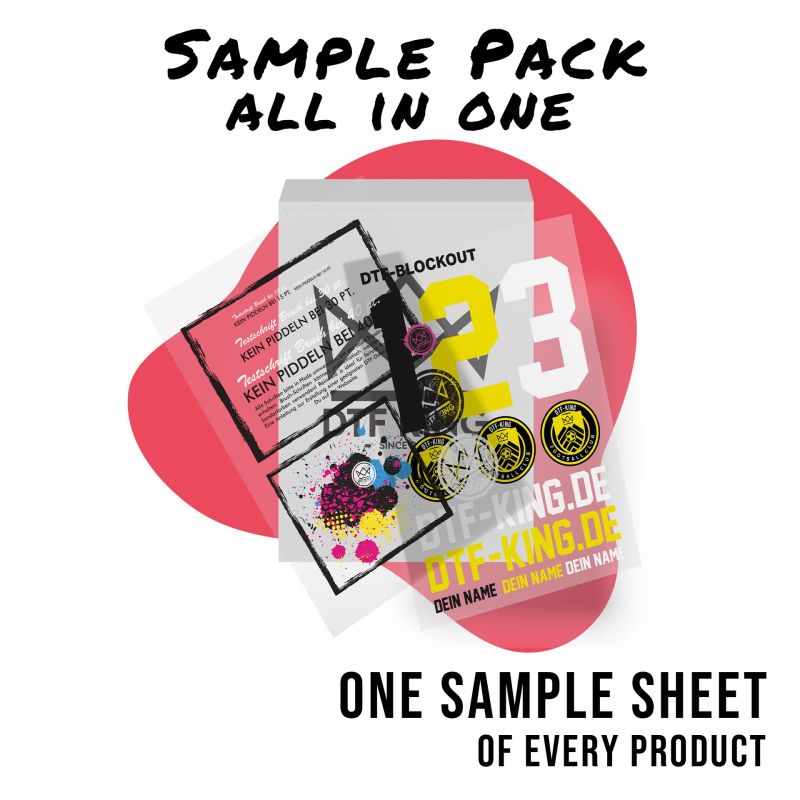 Sample Pack
€0.01
all processes to test
Prices excl. VAT plus shipping costs
View product: Sample PackFrequently asked questions
Does Blockout completely rule out discolouration?
No. Blockout reduces the risk significantly, but cannot rule it out for every textile. Even with the same manufacturer, production batches differ in the strength of the dyeing and therefore in the amount of free colour particles. So test your textile first and only assess the result after it has cooled down completely.
Do I need to set anything up in my print file for Blockout?
No. The Blockout adhesive is used automatically in production, so you do not need to create a separate layer or colour channel for it. You set up your print files as for any DTF transfer. All requirements are listed under Setting up print files correctly.
What do I do if colour still bleeds through?
Stop processing and send our customer service your order number, clear photos, the exact material name as well as the temperature, pressing time and pressure. We will check the details with you and narrow down the cause.
View Blockout DTFView Standard DTFView Sample Pack
Also useful: Heat press settings, Setting up print files correctly, Ordering process and FAQ.
Not sure about a textile? Our team will be happy to help you choose the right DTF transfer, by phone on +49 2163 9518930 from Monday to Friday between 9:00 and 16:00 (German time) or by email at info@dtf-king.de. You can find all the ways to reach us on our contact page.
Related articles

19/09/2024
Which product suits my project?


29/10/2024
Creating a CutContour
Wishing you every success with your projects,
DTF-King Team


