


Pressed correctly and washed at 30 °C, our DTF transfers last at least 60 washes. How far beyond that a print gets depends on three things: the right textile, correct pressing and care. Because your customers wear and wash the printed textiles, it pays to have all three under control. In this article, you will learn what affects durability, how to press and wash correctly, what helps if a print comes loose and which care instructions to give your customers.
What determines how long a DTF print lasts
During pressing, the adhesive of the transfer bonds firmly with the fibre. How long this bond lasts depends on five points:
| Point | Lasts long | Costs durability |
|---|---|---|
| Textile | cotton with Standard DTF, polyester with Blockout DTF | coated or impregnated fabrics, nylon, non-woven fabric, heavily textured fabrics |
| Pressing | values from the heat press settings, first result checked | too little temperature, time or pressure, seams under the design |
| Design | lines from 0.4 mm | finer lines, for which there is no guarantee of adhesion |
| Care | 30 °C, inside out, detergent without enzymes | tumble dryer, fabric softener, ironing over the design |
| Storage | dry, airtight, used promptly | humid storage, the adhesive becomes oily |
The right textile
- Standard DTF: for 100% cotton or blends with at least 70% cotton. Your design is backed with opaque white.
- Blockout DTF: for polyester and blends with 40% polyester or more. Its special adhesive holds back dyes from the textile and clearly reduces the risk of dye migration, although it cannot rule it out for every textile.
- Not suitable: coated or impregnated fabrics, waxed fabric, nylon, non-woven fabric and heavily textured fabrics.
- Do not pre-wash: We recommend not washing textiles before pressing, to avoid problems during pressing.
With new textiles and before larger runs, it is best to test a sample first. Which textiles are suitable for DTF printing? shows you which transfer suits which fabric.

Pressing correctly: the basis for every wash
A print that has not been pressed correctly will not last long, even with the best care. Stick to our guide values:
| Standard DTF | Blockout DTF | |
|---|---|---|
| Temperature | 130 to 140 °C | 120 to 130 °C |
| Pressing time | 12 to 15 seconds | 12 seconds |
| Pressure | medium, around 3 bar | medium, around 3 bar |
| Peeling | warm or cold | warm or cold |
- Allow for tolerances: Every heat press has its own tolerances for temperature and pressure. So check the first result before you press a series.
- Flat surface: Lay the textile flat on the press. Seams, buttons or zips under the design interfere with even pressure.
- Peeling: When the press opens, count 1, 2, 3 and then peel off the film quickly and flat.
- Re-pressing: If a corner lifts, place the transfer film that the design was on back over it and press the area again.
- Rub test: After the first pressing, carefully rub the colour side with a slightly damp cloth or your finger, without creating heat from friction. No colour may come off.
You will find all values and tips in our heat press settings.
 Standard DTF by the metre
From €11.00
600 x 1000 mm, for cotton
Prices excl. VAT plus shipping costs
View product: Standard DTF by the metre Blockout DTF by the metre
From €14.30
600 x 1000 mm, for polyester
Prices excl. VAT plus shipping costs
View product: Blockout DTF by the metre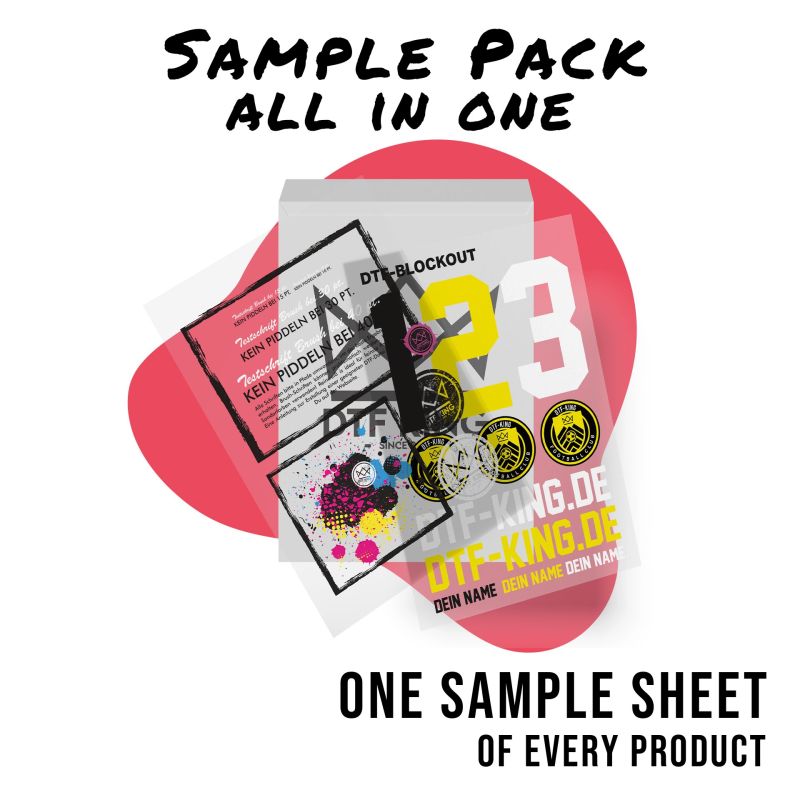 Sample Pack
€0.01
all processes to test
Prices excl. VAT plus shipping costs
View product: Sample PackWashing and care: how the print stays looking good
How far a print gets beyond the 60 washes depends mainly on care. These rules apply to all textiles with a DTF transfer:
- Wait 48 hours before washing: During this time, the adhesive and ink layers stabilise.
- 30 °C and inside out: on a delicate or easy-care programme and without high spin speeds.
- Do not overload the machine: A lighter load reduces friction. Do not wash printed textiles together with coarse fabrics such as jeans or towels.
- The right detergent: a liquid colour or delicate detergent without enzymes. Enzymes attack the surface of the print, and bleach and optical brighteners are not recommended either.
- No fabric softener, no tumble dryer: Let the textile air-dry inside out.
- Do not iron over the design: and do not use steam. Dry cleaning is not suitable.
- Take care with zips and rubber patches: They can damage the print in the wash.
Directly after pressing, a print sometimes feels slightly oily. This film and adhesive residues disappear after washing.
Care instructions for your customers
Your customers wash the textiles, not you. So give them our care instructions to print: they sum up all rules with care symbols in German and English, and you will find them on every DTF product page in the Template tab. Adding them to every order helps prevent queries and complaints.

If a print comes loose, cracks or discolours
| Problem | Common cause | What helps |
|---|---|---|
| Corners lift, parts stay on the film | temperature, time, pressure or material are not right | re-press with the transfer film, check heat press settings, test the material |
| Fine details come loose | lines thinner than 0.4 mm | check the line thickness in the file |
| Cracks or abrasion after washing | care | 30 °C inside out, no tumble dryer, no fabric softener |
| Light areas discolour on polyester | dye migration from dyed polyester | use Blockout DTF, test first |
| Transfer feels oily or adheres less well | stored in conditions that are too humid | store dry and airtight, use promptly |
You can read more about each problem in Most common mistakes and how to fix them, and everything about dye migration in Blockout DTF transfer for critical textiles. If something is still not right, email us at info@dtf-king.de with your order number.
Storing transfers correctly
Transfers that have not yet been pressed can be stored for up to 6 months under optimal conditions. The adhesive absorbs moisture from the air, and transfers stored in conditions that are too humid can become oily or lose their adhesion. So store them dry and airtight and use them as soon as possible.
And with sublimation and UV DTF?
- Sublimation: The ink sits inside the material instead of on top of it, and nothing peels off when it is processed correctly. Wash textiles according to the care label of the item, and finished mugs are best washed by hand. More in Sublimation explained.
- UV DTF: Rub-on stickers are weatherproof and UV-resistant. They are not food-safe and there is no general approval for the dishwasher, so drinkware is best washed by hand. More in Rub-on stickers or vinyl stickers?.
- Screen printing and DTG: DTF printing vs screen printing vs DTG shows you how DTF differs from other processes in durability and feel.
Frequently asked questions
How long does a DTF print last?
Pressed correctly and washed at 30 °C, our DTF transfers last at least 60 washes. How far beyond that you get depends mainly on care.
Does Blockout DTF last just as long?
With the same care, Blockout DTF lasts a similar length of time. Still, test new polyester textiles for dye migration first.
What do I do if a corner comes loose?
Place the transfer film that the design was on back over it and press the area again. Then check the heat press settings and the material so that it does not happen again on the next textile.
Can I wash DTF prints at 40 or 60 °C?
We recommend 30 °C, turned inside out. The at least 60 washes apply to this care.
Can a printed textile go in the tumble dryer?
No. Let the textile air-dry inside out and do not use fabric softener either.
When can I wash a freshly printed textile for the first time?
No earlier than 48 hours after pressing. During this time, the adhesive and ink layers stabilise.
Can I iron over the print?
Not directly over the design, and do not use steam.
Why does the print feel oily after pressing?
That is a film from the adhesive. It disappears after washing, as do adhesive residues. If a transfer already feels oily before pressing, it was probably stored in conditions that were too humid.
How long can I store transfers before pressing?
Under optimal conditions for up to 6 months, dry and airtight. Nevertheless, use them as soon as possible.
Should I wash textiles before pressing?
No. We recommend not washing textiles beforehand, to avoid problems during pressing. The best way to find out how a particular textile behaves is to test it on a sample first.
Which care instructions do I give my customers?
Our care instructions to print with all care symbols, in German and English. You will find them on every DTF product page in the Template tab.
View Standard DTFView Blockout DTFHeat press settingsView the Sample Pack
Also useful: care instructions to print, Setting up print files correctly and FAQ.
Related articles

07/06/2024
Most common mistakes and how to fix them


03/02/2023
Blockout DTF transfer for critical textiles
Wishing you every success with your projects,
DTF-King Team


